
Butt Woods and LEB: What Are You Actually Paying For?

Written by Stuart J. Lacey, Managing Director, BCE Distributors Limited.
Most useful for: Improving Player / Performance Purist / Cue Enthusiast

Question answered
Does an expensive butt wood make a cue play better?
Short answer
Butt material matters because it contributes to mass, balance, stability and character, but an expensive wood does not automatically create a better cue. Ebony has traditional prestige and density; LEB is an engineered laminated ebonised blackwood designed for consistency and stability; Sapele and other hardwoods have legitimate roles at different price points. The material should complement the complete cue.
Why this matters to you
This is where technical performance and ownership pleasure meet. A player can legitimately value appearance and craftsmanship, but the buyer should understand whether they are paying for structural function, rarity, hand work, aesthetics or a combination.
Ebony
Ebony has long held a premium position because of its density, natural mass and distinctive appearance. As a natural material, it also brings sourcing complexity, CITES considerations and the possibility of movement or cracking if the timber is not carefully selected, seasoned and controlled.
LEB
LEB—Laminated Ebonised Blackwood—is built from bonded timber layers to form a dense, stable blank before ebonising and turning. Its laminated structure helps distribute natural stresses and is used by BCE and Riley as a modern, high-density foundation for premium butt construction.
Sapele and other hardwoods
Sapele offers attractive grain, good working properties and structural stability. Entry-level cues can also use other hardwoods appropriately; a beginner does not need expensive Ebony or LEB if the cue is straight, reliable and well balanced.
How should this influence your choice?
If performance is your only objective, do not assume a rarer material automatically improves play. If you are an enthusiast, the story, timber character, splicing and individuality may legitimately be part of the value.
Riley/BCE example
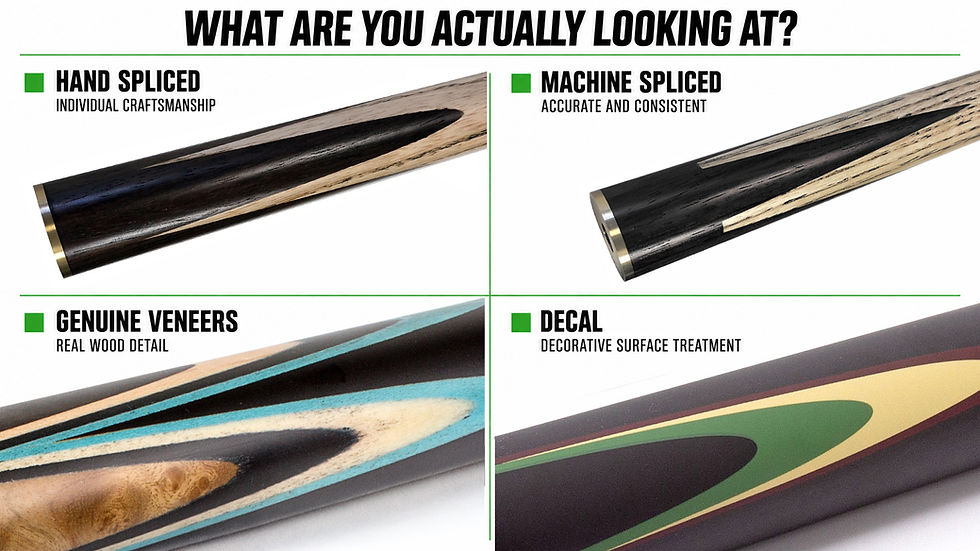
Riley England and Burwat Black use LEB butt foundations within premium architectures. Burwat Black adds exotic wood splicing, genuine veneers and made-to-order characteristics; at that level the buyer is paying for playing architecture and craftsmanship together.
Your decision
First cue: prioritise straightness, balance and suitability over exotic butt material.
Improving player: make sure the upgrade improves architecture, not only decoration.
Enthusiast: ask exactly what is genuine timber, engineered timber, veneer, splice or graphic.
The takeaway
Next: read Splicing, Veneers and Decals if the craftsmanship and visual construction are part of your decision.


Comments