
How to Assess a Cue Before You Buy: 10 Checks That Actually Matter

Written by Stuart J. Lacey, Managing Director, BCE Distributors Limited.
Most useful for: New Regular / Improving Player / Performance Purist / Gift Buyer

Question answered
What should I physically check, and what can I realistically assess online?
Short answer
Check the cue as a complete object: straightness, shaft grain and taper, tip condition, ferrule alignment, joint fit, balance, butt materials, finish and - where possible - how it plays. Online, detailed specifications, close-up photography, video, returns reassurance and adviser access become important because feel cannot be fully digitised.
Why this matters to you
This is the point where technical knowledge becomes a buying action. You do not need to become a cue maker; you need a repeatable way to decide whether the cue is suitable and well made.
Check the cue's straightness
Sight carefully down the complete cue and then along the shaft. Look for obvious bends, changes in direction or movement that could affect delivery. A perfectly still visual line is reassuring, but minor natural variation should be judged alongside how the cue actually plays.
Examine the shaft grain
Look at the ash feathers and how consistently they run along the shaft. Clear, reasonably even grain can help with visual alignment, but attractive grain alone does not guarantee that a cue will play well.
Assess the shaft taper
Run the shaft through your bridge hand and consider whether the taper feels smooth and progressive. There should be no unexpected ridges or abrupt changes in diameter that interfere with the cueing action.
Inspect the tip
Check that the tip is the expected diameter, correctly shaped and securely fitted. It should sit centrally on the ferrule without obvious overhang, gaps or damage.
Check the ferrule
The ferrule should align cleanly with the shaft and tip. Look for cracks, distortion, uneven fitting or visible gaps where the ferrule meets the wood.
Test the joint
Assemble the cue and make sure the joint engages positively without looseness or resistance. The two sections should align cleanly and should not introduce obvious movement into the assembled cue.
Consider the balance
Hold the cue naturally in your normal stance rather than searching for one universal balance point. Ask whether it feels coherent between your cueing hand and bridge. If upgrading, compare it directly with your existing cue.
Understand the butt construction
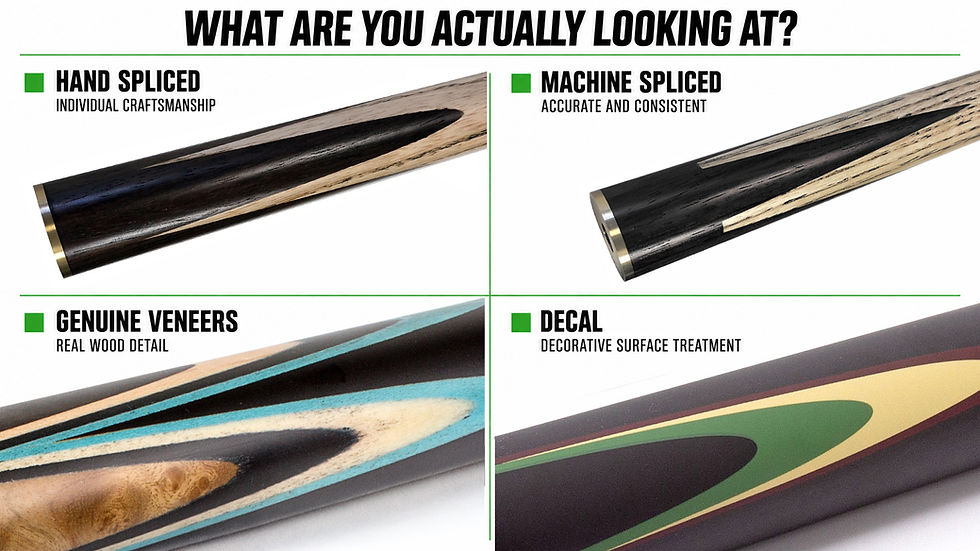
Identify what you are actually buying: genuine wood, LEB, Sapele or another hardwood; hand or machine splicing; genuine veneers or decorative decals. These differences affect appearance, craftsmanship and price more than basic suitability.
Understand the butt construction
Check the finish, splice edges, badge, chamfer, joint and extension fittings. The workmanship should appear clean and consistent, without rough edges, lifting decoration or poorly aligned components.
Understand the butt construction
Try centre-ball stun, screw, top, side, a long pot, a positional shot and a controlled power shot. Pay attention to feedback, confidence and consistency rather than looking for a dramatic first impression.
The online buying reality
A Performance Purist may need individual cue information, detailed imagery, video and adviser access. A New Regular needs simpler reassurance and an appropriate shortlist. A Gift Buyer needs exchange flexibility if the recipient has established preferences.
Your decision
Use the same checklist every time you compare a cue.
Online: demand enough evidence for your experience level.
If buying for someone else and you cannot verify their preferences, preserve choice through exchange or voucher options.
The takeaway
Next: use the Cue Finder to translate these checks into a shortlist, then apply this assessment before purchase.


Comments