
Hand Spliced, Machine Spliced, Veneers and Decals: What Is the Difference?

Written by Stuart J. Lacey, Managing Director, BCE Distributors Limited.
Most useful for: Cue Enthusiast / Performance Purist / Improving Player
Question answered
Does hand splicing play better, and how can I tell genuine wood detail from decoration?
Short answer
Hand splicing is more labour-intensive and individual, but it does not automatically make a cue play better than a well-made machine-spliced alternative. Genuine veneers and inlays use real pieces of wood, while decals reproduce complex visual effects at a lower cost. The important buying principle is honest description and understanding what the additional cost is actually buying.
Why this matters to you
This subject is often misunderstood because visual complexity can easily be mistaken for playing performance. Craftsmanship and decorative detail may add genuine ownership value, but they should not be used to disguise ordinary materials or construction.
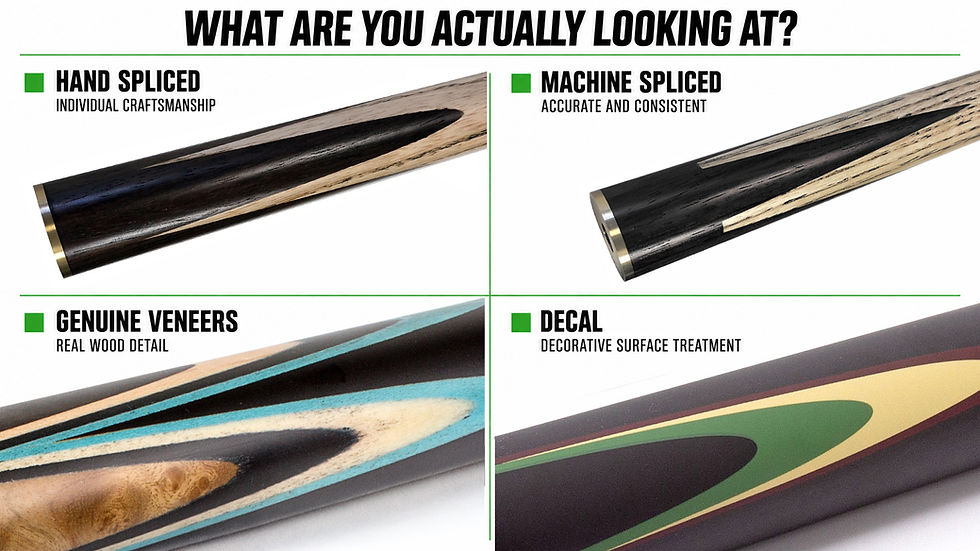
Hand splicing
Hand-spliced points tend to have softer, more organic shapes and greater natural variation. The process requires skilled labour, additional time and individual attention, which is why a genuinely hand-spliced cue usually costs more.
Machine splicing
Modern machinery can produce highly accurate and repeatable spliced sections. Machine-spliced points tend to appear sharper and more uniform. When equivalent materials and sound construction are used, machine splicing is not automatically inferior in playing terms.
Veneers and genuine inlays
Thin pieces of real wood can be stained and integrated into the butt for decorative effect. Natural materials create variation, which is part of the appeal at premium levels.
Decals
A well-made cue decal is normally applied to a prepared surface and sealed beneath the lacquer. It can reproduce complex decorative treatments at a lower cost and remain durable when correctly applied. The issue is not whether decals are “bad”; it is whether they are described honestly rather than presented as genuine woodwork.
Riley/BCE examples
Riley Burwat Black and Riley England use genuine veneers and premium splicing within higher-end architecture. BCE Heritage uses matching-grain shaft construction on selected two-piece cues, illustrating that craftsmanship can also appear in technically useful visual continuity.
Your decision
Performance-first buyer: Do not pay extra solely because the points are hand spliced.
Cue enthusiast: Pay for craftsmanship when the making, individuality and ownership experience are part of what you value.
Any buyer: Ask what is genuine wood, what is engineered material and what is a decorative treatment.
The takeaway
Splicing method and decorative detail can add craftsmanship, individuality and ownership value, but they do not determine playing quality on their own. Understand what has been constructed, what has been applied and whether the additional cost reflects something you genuinely value.
Next: Read "What You Get When You Spend More" to separate meaningful progression from decoration alone.


Comments