
Cue Shafts Explained: Ash, Grain, Density, Flex and Taper

Written by Stuart J. Lacey, Managing Director, BCE Distributors Limited.
Most useful for: Improving Player / Performance Purist / Cue Enthusiast
Question answered
What actually makes one ash shaft different from another?
Short answer
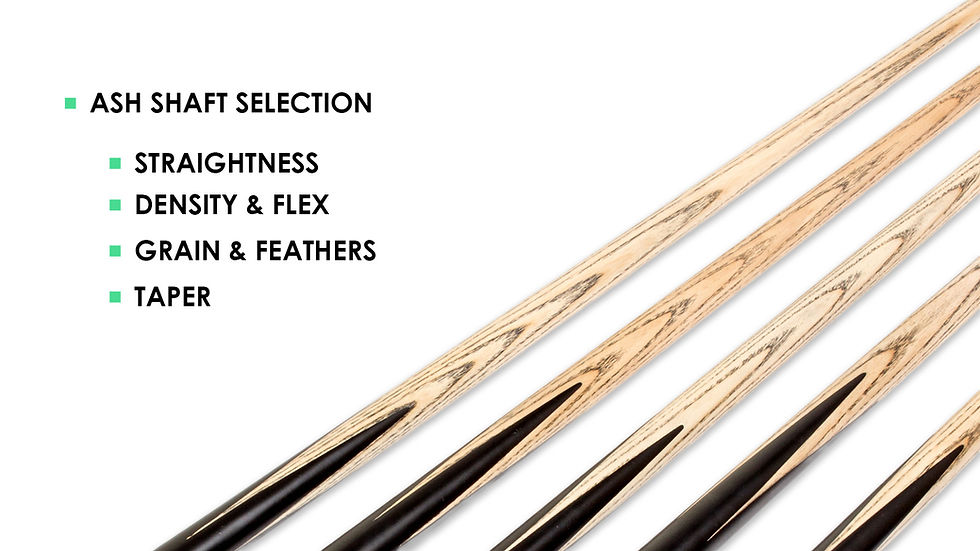
Shaft quality is not defined by the word ash alone. Straightness, grain, density, stiffness, taper, stability and preparation all affect feel. Attractive feathers are desirable, but visual grain is not the same thing as playing quality. As a player improves, shaft selection becomes increasingly relevant because small differences in stiffness and taper become easier to feel.
Why this matters to you
The shaft is the principal playing section of the cue. If you are upgrading, this is one of the most meaningful areas to understand because it affects how the cue feels through the bridge and how directly it responds during the stroke.
Ash is a starting point, not the whole answer
Ash is the traditional shaft timber for snooker and English pool because of its visible grain and familiar playing characteristics. But two ash shafts can differ markedly. Grain spacing, density, straightness and stiffness all vary naturally, which is why selection matters.
What do the feathers tell you?
The pointed grain patterns are often called feathers or arrows. Some players use them as an alignment reference and prefer consistent direction and spacing. Higher-grade selection can improve visual quality, but a beautiful pattern should never be treated as proof of ideal density or feel.
Density and flex
A denser-feeling shaft tends to feel firmer; a less dense shaft may feel livelier or more flexible. Riley/BCE's technical guide describes the traditional palm test as a practical way to compare vibration and recovery. It is not a laboratory test, but it helps explain why two shafts can feel different even when they are the same species.
Taper
The taper controls how the cue passes through the bridge and interacts with shaft stiffness. A very fine front end can feel precise but may be more flexible and vulnerable. A fuller taper can feel firmer. The correct choice depends on the game, front-end dimensions and player preference.
Riley/BCE example
The technical guide positions higher-grade ash selection as increasingly important as players progress. Riley England and Burwat Black use high-grade ash within premium cue architectures, while BCE Grand Master uses selected ash for serious intermediate through expert players. That is the practical meaning of paying more for shaft selection: the material is selected more carefully for the intended level.
Your decision
New Regular: do not buy on feather pattern alone; prioritise straightness and a dependable complete cue.
Improving Player: compare how your current shaft feels—firm, soft, lively, thick or fine—before changing.
Purist: ask about density, taper and actual shaft selection, not merely "premium ash".
The takeaway
A good shaft is judged by how its straightness, density, stiffness, taper and preparation work together—not by attractive grain alone.
Next: If your main concern is side spin and cue-ball behaviour, read the Flex, Squirt and Swerve article.


Comments