
One-Piece, 3/4, 5/8 or Two-Piece: Which Cue Configuration Is Right for You?

Written by Stuart J. Lacey, Managing Director, BCE Distributors Limited.
Most useful for: New Regular / Improving Player / Performance Purist
Question answered
Is one-piece always better, or should I buy a 3/4 cue?
Short answer
One-piece is the traditional purist construction, but 3/4 cut is often the practical performance choice because most of the shaft remains uninterrupted while the cue is easier to transport. Two-piece cues are practical and accessible for first-time and intermediate owners. BCE's 5/8 configuration is a long-standing alternative whose appeal is mainly styling and preference rather than an automatic performance advantage.
Why this matters to you
Configuration changes how the cue transports, where mass is introduced and how much uninterrupted shaft remains. It matters, but there is no single hierarchy that suits every player.
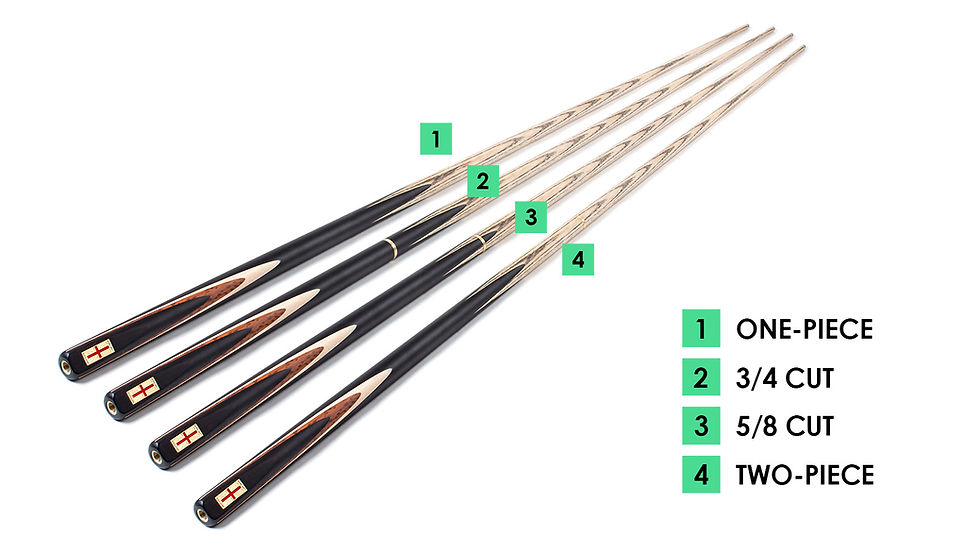
One-piece
A genuine one-piece cue represents traditional cue manufacture at a high level. It is treated as one unit through much of the build and can carry a higher reject risk because a late defect can waste more material and labour. Its main disadvantage is simple: a 57-inch cue is harder to transport and protect.
3/4 cut
The joint sits towards the rear, leaving one long piece from joint to tip. The guide notes that many experienced and professional players prefer 3/4 cut, and that most players would find the playing feel close to one-piece while gaining much better portability.
5/8 cut
BCE has long been associated with bringing the 5/8-cut cue to market. It is not inherently better or worse than 3/4; it is an alternative architecture with its own style and preference.
Two-piece
The centre joint makes the cue compact and practical. It is widely used by beginners and intermediate players and is an excellent introduction to owning a personal cue. As standards rise, smaller differences in alignment and joint feel become more relevant.
Riley/BCE example
BCE Grand Master is 3/4 cut and aimed at serious intermediate through expert players. Riley Burwat Black can be specified by configuration/cut within its made-to-order approach. This illustrates the real principle: configuration should follow the player and use case, not a blanket rule.
Your decision
Travel and convenience matter? Start with two-piece or 3/4.
Serious snooker player wanting traditional feel with practicality? 3/4 is a strong place to look.
Purist who values traditional construction and can manage transport? One-piece may be worth considering.
The takeaway
Next: the Cue Finder asks about portability and playing level before recommending a configuration pathway.


Comments